Leverage Withe's hiring event platform
Streamline your seasonal and high-volume hiring process and hit your hiring targets.
For recruiters, a career fair keeps working for weeks after the booth comes down. The booth creates interest, and the follow-up decides whether that interest becomes applications, interviews, and hires. Fair candidates do move forward: more than 45% of students who attended a career fair received an interview invitation afterward, and nearly one-quarter were offered a job, according to NACE's 2024 Student Survey (NACE). Those invitations came from employers who followed up.
This post covers why speed matters, what to send, a timeline for the first three weeks, how to decide who hears from you first, and how to track every candidate so the fair shows up in your hiring results.
Leverage Withe's hiring event platform
Streamline your seasonal and high-volume hiring process and hit your hiring targets.
Why does timely follow-up matter after a career fair?
Timely follow-up matters because a career fair candidate is warmest in the first day or two, and silence reads as a no. In Criteria's 2026 Candidate Experience Report, 53% of job seekers said an employer had ghosted them in the past year, up from 38% in 2024 (Fortune). Candidates also expect speed: in Greenhouse's 2022 Candidate Experience Report, 58% of job seekers said they expect to hear back in a week or less (UNLEASH). A recruiter who writes back within days stands out against that.
A fair conversation also gives the recruiter a head start. The candidate has met someone at the company and remembers what they talked about, and that memory fades on both sides. Withe's guide for career fair organizers notes that details fade fast once people leave the building, which is why the best follow-up refers to the conversation itself.
What should recruiters send after a career fair?
Every follow-up should do three things: thank the candidate, remind them of the conversation, and give one clear next step. The next step depends on where the candidate stands, so the message changes with it.
A candidate who fits an open role should hear from the recruiter they met, in a short personal note that mentions something specific from the conversation and links straight to the application page for the role they discussed, or invites them to interview. A strong candidate with no matching role yet should get the roles that fit their interests and a way to hear about new openings, such as job alerts or a talent community. A candidate who isn't a fit should still get a brief, respectful thank-you, because they will talk about the experience and may apply again later. In Talent Board research covering more than 130,000 candidates, reported in 2019, those who received feedback on the same day as their interview were 52% more likely to deepen their relationship with the employer, and those who got none were twice as likely to end it (HR Dive).
Two details make any follow-up easier to act on. Put the fair's name in the subject line, so the candidate recognizes the message among the others they received that week. And if the resume hasn't arrived, ask for it in the same message. TalentSync handles that step automatically: it emails every candidate the moment they connect at the booth and asks them to upload a resume, so the recruiter's first personal message can focus on the role.
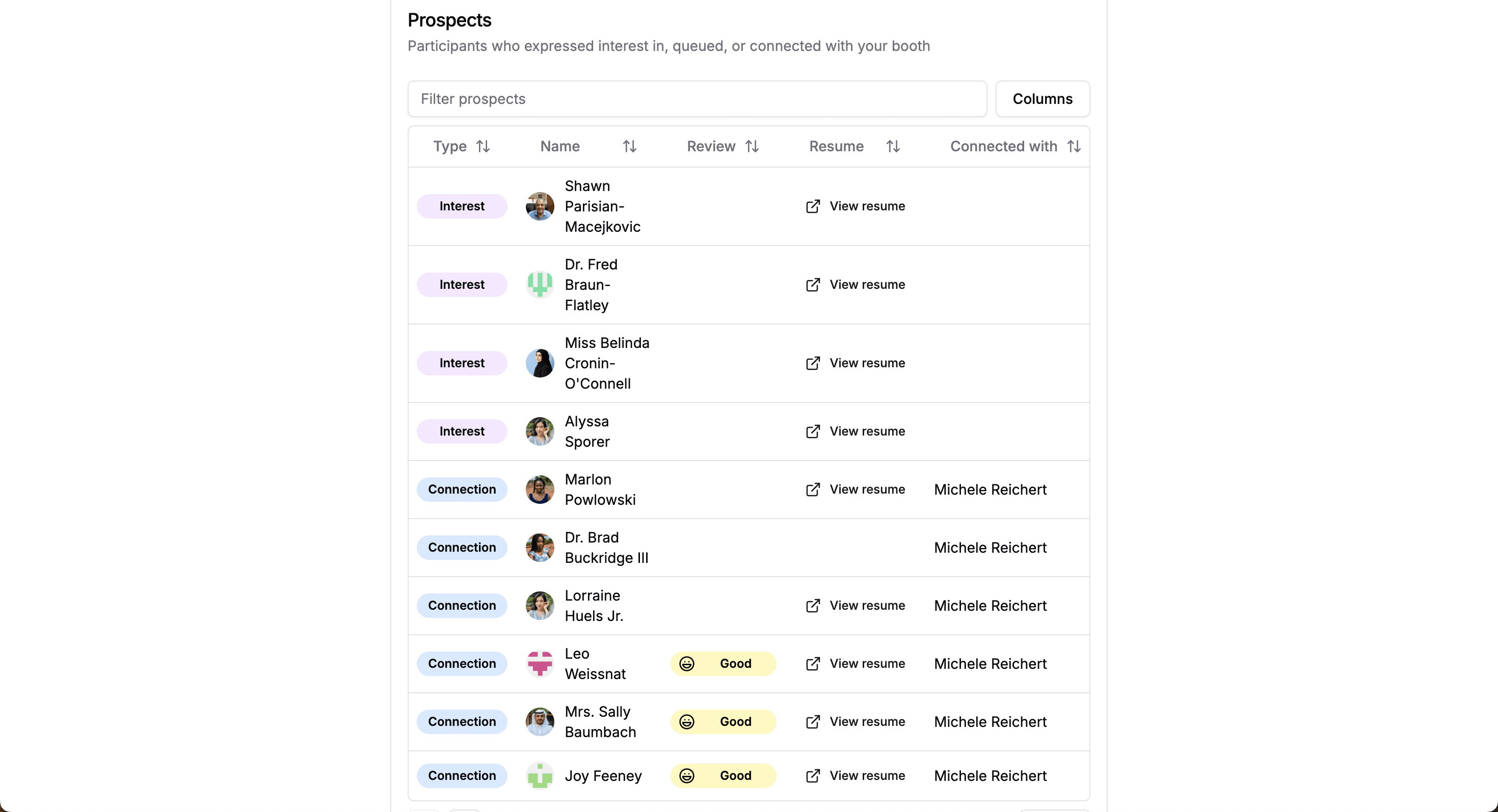
TalentSync gives every recruiter at your booth one prospect list, with resumes, notes, and ratings ready for follow-up.
When should recruiters follow up?
Follow up in stages over three weeks, with the most effort in the first two days, when candidates are warmest. The timeline below ends with a clear answer for everyone, because a closed loop protects the employer's reputation for the next fair.
| When | Who hears from you | What it does |
|---|---|---|
| Same day | Everyone who connected at the booth | Confirms the connection and asks for a resume, automatically in TalentSync |
Within 24 hours | Top-priority candidates, and their hiring managers | A personal thank-you with the next step, and the shortlist sent to hiring managers |
Within 2 to 3 business days | Everyone else you met | A thank-you with matching roles and how to apply |
Within 1 week | Shortlisted candidates | Interview invitations, plus a reminder to anyone who hasn't replied |
Weeks 2 to 3 | Candidates who aren't moving forward | A clear, polite close, with an invitation to apply for future roles |
The one-week reminder earns its place. In Gem's email benchmarks for 2024, drawn from 4 million recruiting outreach emails, a four-stage sequence received twice the replies of a one-off email, and engagement flattened after the fourth message (Gem). A reminder or two is worth sending, and past the fourth message the returns level off.
The hiring manager handoff belongs in the first 24 hours too. Interview invitations can only go out as fast as hiring managers review their shortlist, so send each manager their candidates with the booth notes attached on the first day.
How should recruiters prioritize candidates after a career fair?
Prioritize by fit and urgency. Candidates who match a role the team needs to fill now come first, strong candidates for future roles come second, and everyone else gets the general thank-you. The ratings recruiters gave at the booth do most of the sorting, which is why a shared rating scale agreed before the fair pays off afterward, as covered in how employers capture candidate details at a busy booth.
Within the top group, start with candidates for the roles with the nearest start dates, and with anyone who told a recruiter they were weighing other offers. The notes taken at the booth hold that context, so read them before sending anything. Then sort the rest by role, so each hiring manager gets one list for their own team.
In TalentSync, the prospect list filters by rating, role, recruiter, school, and fair, so the priority list takes minutes to build. Campus teams covering several schools can work from one master list for the whole season.
How do you track follow-up and next steps?
Track every candidate from the fair to an outcome: contacted, replied, applied, interviewing, hired, or closed. That record is how the fair shows up in hiring results, and how next year's decision about which fairs to attend gets made on evidence.
The simplest setup is the exported prospect list with a status column added, or the candidates moved into the ATS with a source tag for the fair. Review the list weekly for the first month: who hasn't heard back, which hiring managers still have open shortlists, and who is waiting on an interview time. TalentSync exports the full prospect list as a CSV, with notes and ratings attached, and enterprise plans send candidates straight into the ATS, with fields aligned by Withe's team.
Tracking also answers a question the fair's organizer may ask. Organizers who report to funders may survey employers about how many candidates they interviewed or hired, as in this follow-up survey template, and a tracked list answers it in a minute. Over a recruiting season, the same record shows which fairs produce hires, which is the number that decides where next year's recruiting budget goes.
Conclusion
Career fair follow-up turns a booth's conversations into hires, and timing does most of the work. Before the next fair, decide who sends which message and when, so the first personal follow-up goes out within 24 hours and every candidate has a clear answer by week three.
TalentSync is free for your first 3 fairs, with no credit card required. See how TalentSync works.
More for employers recruiting at career fairs: